One-Person Media Studios: How Solo Creators Are Outproducing Teams
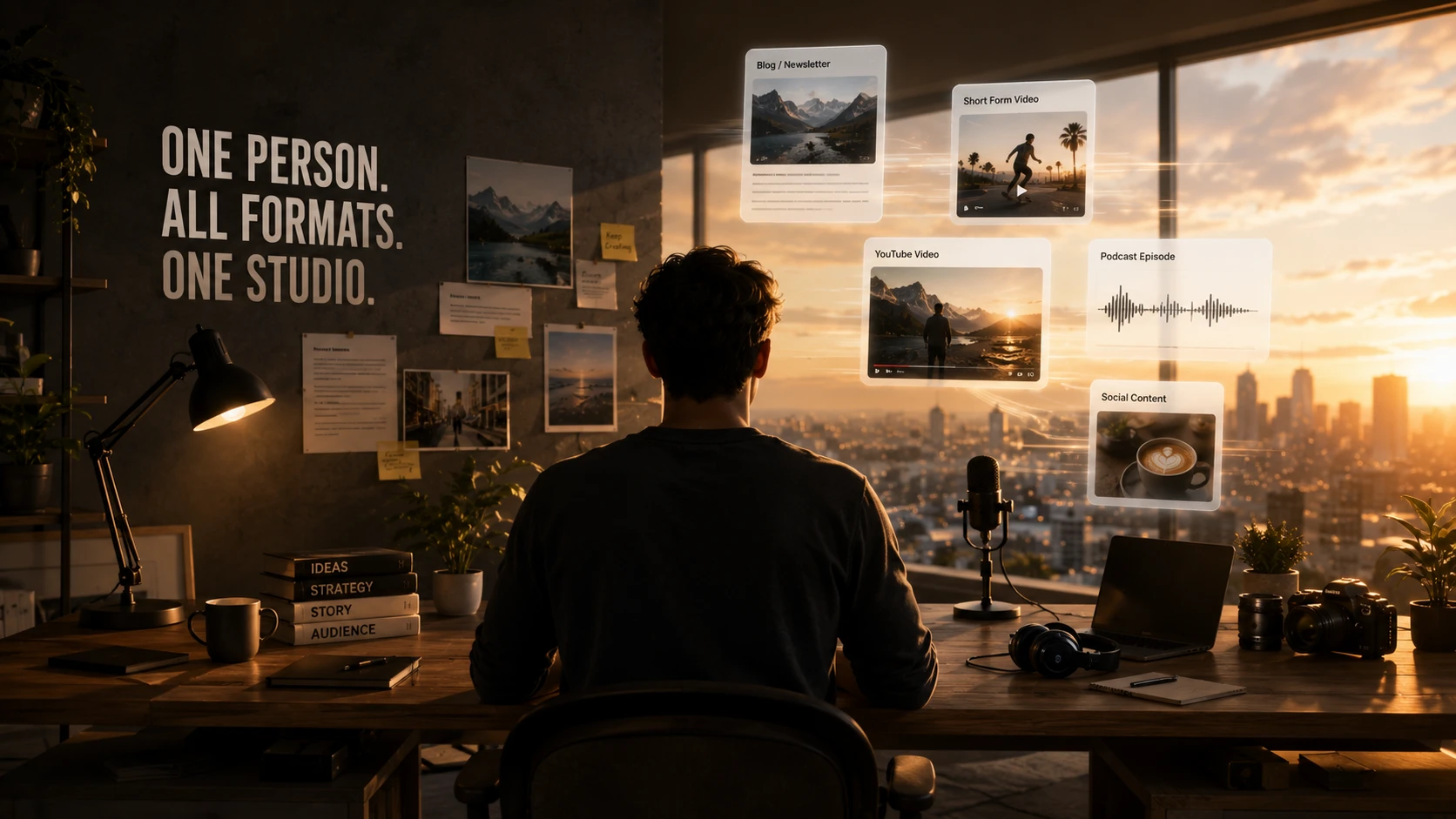
There's a category of creator emerging that didn't exist in any meaningful form five years ago: the one-person media studio.
Not a solo blogger. Not a single-channel YouTuber. A genuinely multi-format media operation - producing written content, short-form video, long-form video, audio, and social content across multiple platforms - run entirely by one person, often as a side operation alongside a business or day job.
The output volume and quality coming from some of these operations is striking enough that it's worth examining what's actually making it possible.
What a One-Person Media Studio Looks Like
To make this concrete: a one-person media studio in 2026 might produce in a single week:
- Three to five long-form blog posts or newsletter issues
- Daily short-form video content across Instagram Reels, TikTok and YouTube Shorts
- A weekly long-form YouTube video
- Podcast episode audio
- A full week of social media content across three to four platforms
That output would have required a content team of four to six people to produce manually at any consistent quality level. It's now achievable by a single organised person with the right AI-powered workflow.
This isn't hypothetical. Creators operating at this output level are increasingly visible across every content category - personal finance, business, fitness, food, technology, travel. The production ceiling for solo operators has shifted significantly.
The Infrastructure That Makes It Possible
The one-person media studio runs on a specific stack of capabilities. Understanding that stack is more useful than any individual tool recommendation.
AI Writing - The Baseline Multiplier
The foundation of high-volume solo content production is AI-assisted writing. Not fully automated writing - the voice, the strategic angle, the editorial judgement still come from the creator. But AI handles the production work: drafting, structuring, expanding outlines, generating variations, reformatting content for different platforms.
A newsletter issue that takes three hours to write from scratch takes 45 minutes with AI assistance. A blog post that takes two hours takes 30. Across a week of content, this time compression is the single biggest leverage point in the solo creator's stack.
AI Image and Video - The Visual Layer Without the Crew
The visual production bottleneck used to be the hardest for solo creators to solve. Photography requires equipment and either a photographer or a setup. Video production requires either being on camera or having footage. Neither scales easily for a solo operator.
AI image generators (Midjourney, Nano Banana) and video tools (Kling, Runway, Seedance) have effectively removed this constraint. A solo creator can produce professional-quality imagery and short-form video without a camera, a photographer, or a video editor. The visual layer of the content operation is now as scalable as the written layer.
AI Audio - The Missing Link
Audio was the last piece of the one-person media studio that AI solved credibly. For a long time, AI voice synthesis was identifiably artificial - useful for some applications, not convincing for narration or podcast-adjacent content.
That's changed. Current voice synthesis tools (ElevenLabs being the standout) produce audio that's genuinely difficult to distinguish from human narration in most listening contexts. A solo creator can now produce voiceover, narration, and audio content without recording themselves - which matters enormously for creators who either don't want to be on mic or who want to produce audio content at a volume that recording would make impractical.
The Integrated Platform - Where It Comes Together
Having access to all of these tools matters. Having them integrated matters more.
The one-person media studio doesn't just need powerful individual tools - it needs a workflow where moving between writing, image generation, video production, and audio creation doesn't require context-switching across five separate platforms.
This is where integrated platforms like glown.ai make a practical difference. Bringing together text, image, video, and audio generation in one interface - with templates and presets that handle the production framework - is what turns a collection of powerful tools into a coherent studio workflow.
The Strategic Advantage of the Solo Studio
Solo creators operating at media studio output levels have advantages that aren't immediately obvious - including some that larger teams struggle to replicate.
Speed of decision-making. A solo creator can pivot topic, change format, or respond to a trending moment in hours. A team operation requires alignment, approval cycles, and coordination overhead. In content formats where timing matters, the solo operator wins on agility.
Voice consistency. Every piece of content produced by a solo studio has the same author - the same voice, the same perspective, the same editorial sensibility. This consistency is extremely difficult for teams to replicate, and audiences respond to it. The sense that you're hearing a genuine, consistent perspective builds the kind of trust that content marketing exists to create.
Operational efficiency. No team means no management overhead, no communication friction, no coordination costs. The energy that goes into managing a content team in a larger operation goes directly into content in a solo studio.
Experimental velocity. A solo creator can test a new format, a new platform, or a new content angle with no internal buy-in required. If it works, double down. If it doesn't, pivot. This experimental velocity compounds over time into content strategy clarity that's hard to acquire any other way.
What the One-Person Studio Can't Do
Intellectual honesty requires noting the genuine constraints of the solo operation.
Sustained output without burnout is still hard. AI compresses production time significantly, but strategic thinking, editorial oversight, community management, and business development all still require human time. The one-person studio runs lean - it doesn't run on zero effort.
Live and relationship-based content is harder to scale. Content that requires genuine human interaction - comments, community, live formats, interviews - doesn't benefit from AI production tools in the same way. The relational layer of audience building is still human work.
Deep specialisation has limits. A solo creator covering multiple formats across multiple platforms is generalist by necessity. Depth in any single format or platform benefits from dedicated focus that the breadth of a full-studio operation can work against.
These constraints are real but navigable. The most successful solo studios tend to be clear-eyed about where they invest human attention versus where they leverage AI production - and they don't try to do everything manually.
The Replication Question
The obvious question: if one person can produce at team-level output with AI tools, what happens to content teams?
The honest answer is nuanced. AI hasn't made content teams obsolete - it's changed what they're for. Teams that were primarily production-focused (writing, design, editing, formatting) are the most exposed. Teams that are primarily strategy-focused (audience development, content direction, brand positioning, community) retain their value clearly.
The more interesting development is what happens at the other end: as solo creators operate at previously-team-level output, the competitive dynamics of content marketing shift. More high-quality content, from more independent operators, competing for the same audience attention.
In that environment, the advantage goes to the creators who combine AI production efficiency with genuine strategic clarity - a distinctive point of view, a well-understood audience, and the editorial discipline to produce content that earns attention rather than just occupying a slot in a publishing schedule.
Building Your Own One-Person Studio
If you're a solo creator or entrepreneur looking to build toward this model, the practical starting point is simpler than it might appear.
Start with the format you know best. Don't try to go multi-format on day one. Build the AI-assisted workflow for your strongest existing format first - get fast and consistent there, then expand.
Consolidate your tools early. The workflow friction of managing multiple separate platforms is the biggest practical obstacle for solo operators. Start on an integrated platform rather than trying to assemble the best individual tool in each category.
Invest in batch production. The one-person studio operates most efficiently in batch mode - planning a week's content, producing it in consolidated sessions, scheduling in advance. This is the difference between running a studio and constantly reacting to today's posting deadline.
Protect the thinking time. AI handles production. You handle strategy, voice, and editorial direction. Protect the time for those things - they're the actual differentiator, and they're the first things to get squeezed when production pressure builds.
The one-person media studio is a real operational model, not an aspirational concept. The infrastructure exists. The workflows are proven. The constraint is execution - and AI has made that constraint smaller than it's ever been.
At Kid's Study Bible, we are dedicated to making the Bible come alive for young minds. Our platform offers a rich blend of interactive maps, captivating stories, and engaging resources tailored for children. With a focus on accessibility and understanding, we break down major Bible sections, explore geography, and provide a kid-friendly glossary. Join us on this exciting journey of discovery, where we strive to make learning about the Bible a joyful and enriching experience for every child.
Introduction and Background
- Genesis
- Exodus
- Leviticus
- Numbers
- Deuteronomy
- Joshua
- Judges
- Ruth
- 1 Samuel
- 2 Samuel
- 1 Kings
- 2 Kings
- 1 Chronicles
- 2 Chronicles
- Ezra
- Nehemiah
- Esther
- Job
- Psalms
- Proverbs
- Ecclesiastes
- Song of Solomon
- Isaiah
- Jeremiah
- Lamentations
- Ezekiel
- Daniel
- Hosea
- Joel
- Amos
- Obadiah
- Jonah
- Micah
- Nahum
- Habakkuk
- Zephaniah
- Haggai
- Zechariah
- Malachi
- Matthew
- Mark
- Luke
- John
- Acts
- Romans
- 1 Corinthians
- 2 Corinthians
- Galatians
- Ephesians
- Philippians
- Colossians
- 1 Thessalonians
- 2 Thessalonians
- 1 Timothy
- 2 Timothy
- Titus
- Philemon
- Hebrews
- James
- 1 Peter
- 2 Peter
- 1 John
- 2 John
- 3 John
- Jude
- Revelation